A Viking Built-In Refrigerator That Runs Warm
Freezer cold and refrigerator warm is an air problem, not a cooling problem. Both compartments warm is a different conversation, and a much more expensive one.
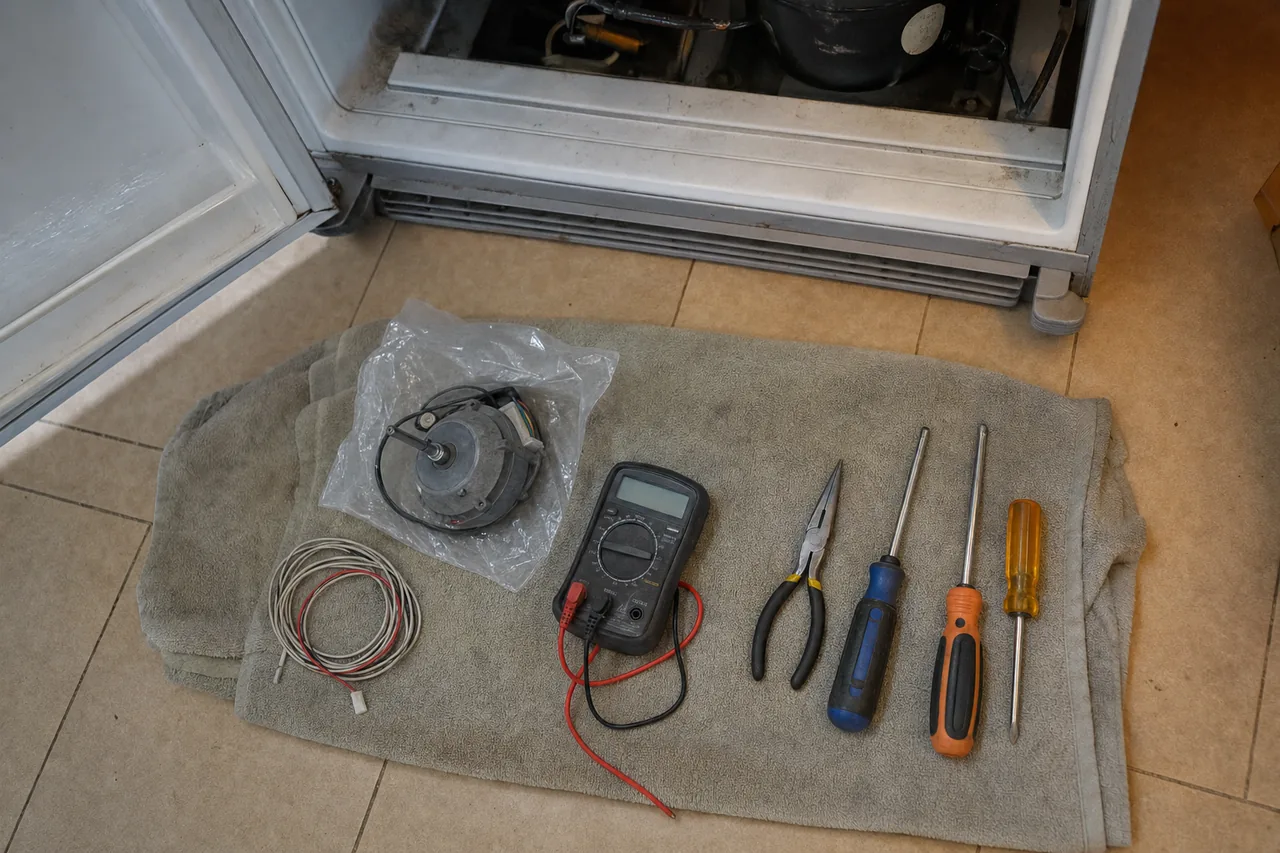
The most useful sentence a customer can say on a refrigeration call is which compartment is warm. It is worth more than any other piece of information, because it splits the problem in half before we have left the shop.
Freezer cold, refrigerator warm
This is an air-management fault nine times out of ten, and it is the more common of the two by a wide margin.
A dual-compartment built-in makes cold in one place and distributes it. If the freezer is still holding, the system is producing cold successfully. What has failed is the distribution: an evaporator fan that has stalled or slowed, a damper that no longer opens, or — most often — a defrost problem that has let frost build across the evaporator until air can no longer pass through it.
That last one is worth understanding because it is self-reinforcing. Frost blocks the coil, airflow drops, the freezer compensates by running longer, the coil gets colder and frosts faster, and the refrigerator side starves. By the time the refrigerator compartment is noticeably warm, the freezer has often been running almost continuously for weeks.
The tell is the back wall of the freezer. Heavy, even frost across the interior rear panel, or an audible fan noise that changes when you open the freezer door, both point straight at this.
Both compartments warm
Now the question is whether the system is making cold at all, and the honest answer is that most of the time it still is — just badly, and for reasons that have nothing to do with refrigerant.
We rule out the cheap causes first, because they are the likely ones:
Condenser condition. A condenser packed with dust, lint and pet hair cannot reject heat. The compressor then runs continuously and still loses ground. This is an afternoon’s work with a brush and a vacuum and it fixes a surprising proportion of “my refrigerator is dying” calls.
Condenser fan. A fan that has slowed or seized produces the same result. It is usually audible if you know what you are listening for.
Airflow around the cabinet. A built-in rejects its heat through a specific path — commonly a grille at the top or at the toe kick. When cabinetry, a retrofit trim kit or stored items block that path, the appliance cooks itself. We see this most in kitchens that were remodelled around an appliance that stayed.
Door seal. A door not pulling fully shut admits humid air continuously. On the Doctors Lake shore, where the air is wet year-round, that alone can push a healthy unit past what it can hold.
Only when those are eliminated does the sealed system become the working hypothesis.
The sealed system, and who may open it
Refrigerant handling is federally regulated. Our technicians hold EPA Section 608 certification, which is required by law to handle refrigerant and is issued by the U.S. Environmental Protection Agency. It is not issued by, and implies no relationship with, any appliance manufacturer. We are an independent company and that is the only credential we claim.
A sealed-system repair is a serious job on a built-in. It usually means removing the appliance from its enclosure, and the estimate reflects that. This is exactly why we will not reach for it as a first explanation: a sealed-system quote given without ruling out a blocked condenser and a failed door seal is a guess with a large number attached to it.
The ice maker is a separate machine
It is worth saying plainly, because it saves a great deal of confusion: an ice maker that has stopped is not evidence that the refrigeration system has stopped. It is a small assembly with its own supply, its own thermostat and its own harvest motor, bolted into a compartment that may be working perfectly.
So it gets worked as its own problem, in order. The fill valve is checked electrically before it is condemned mechanically. The water line is checked where it enters the cabinet, which is where it gets pinched during an installation and where it freezes when the compartment runs cold. The harvest mechanism comes next. Last is the compartment temperature itself, because a unit running a few degrees warm will make ice and then fail to release it cleanly. Hollow or undersized cubes point at fill volume; a cold mold with no cubes at all points at the harvest side.
Terms
Flat $80 diagnostic, credited toward the repair when you approve the work. Written estimate before any part is ordered. Genuine OEM parts, 90 days on labour and 365 days on parts.
What does this built-in refrigeration work cost?
The bands that fit this fault, not the whole book. Parts and labour together.
| Work | Usual range | What moves it inside the band |
|---|---|---|
| Finding the fault | $80 | Nothing moves it. One figure for any appliance anywhere in the radius. Flat diagnostic fee, credited toward the repair when you approve the work. |
| Refrigeration fan or defrost system | $240–$630 | How much of the defrost circuit is involved — heater, sensor, board — and whether the cabinet has to be emptied and drawn forward. |
| Compressor or sealed-system repair | $980–$2,630 | Sealed-system work is refrigerant handling and a long labour block. On the oldest cabinets this is where we say replace rather than quote. |
Parts and labour together, for this equipment in Orange Park and the rest of the radius. A band is not a quote: the figure you approve is written down once the appliance has been measured, and it lands inside the band above unless you are told on the day why it does not. The whole book, and the replace-instead comparison.
What this one raises
- How quickly does a compartment drifting warm matter?
- Sooner than the appliance suggests. A cabinet that has drifted a few degrees over a month tells you nothing until something spoils early, and by then it has usually run hard enough, long enough, to have worn something else out with it.
- Is defrosting it overnight a real test?
- It is a useful one. If a manual defrost restores normal temperatures for a few days and then the same drift returns, the sealed system is doing its job and the defrost circuit is not. That single observation saves an expensive assumption.
- What does this repair cost in Orange Park?
- $80 flat to find the fault, and that is the whole bill if you decide to stop there. Where the work goes ahead, the bands that apply are refrigeration fan or defrost system $240–$630, compressor or sealed-system repair $980–$2,630, parts and labour together. You get a written estimate before any part is ordered or any labour is billed.
The service this belongs to
- Refrigerationrefrigeration
Where this comes up
- Orange Park32073
- Pace Island32073
- Doctors Lake32073
Book a diagnostic
Tell us the model line and the symptom. We schedule Viking work only, so the van carries the right parts.
- Diagnostic
- $80
- Labour warranty
- 90 days
- Parts warranty
- 365 days
Flat diagnostic fee, credited toward the repair when you approve the work. You get a written estimate before any part is ordered or any labour is billed.
Monday to Friday 8:00 am to 6:00 pm, Saturday 9:00 am to 4:00 pm. Closed Sunday.