A Viking Burner That Sparks But Will Not Light
The click is the spark module doing its job. If gas is present and the burner still will not catch, the fault is almost always upstream of the burner cap.
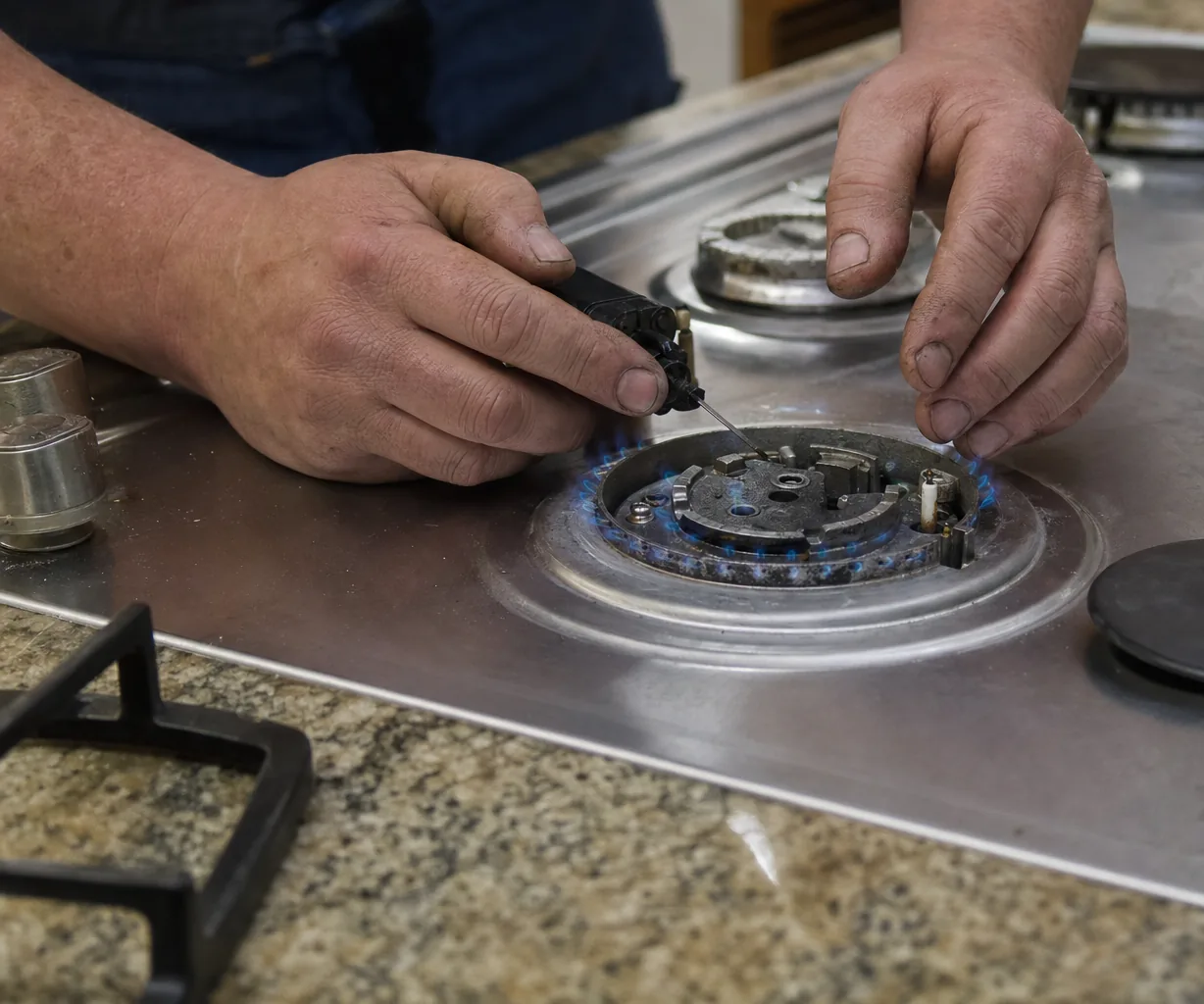
Somebody turns the knob, the module clicks steadily, and nothing lights. It is the most common range call we take, and it is worth understanding what the click is telling you.
The click is not the problem
The clicking is the spark module firing. Hearing it means the module has power and at least one output is alive. What it does not tell you is whether the spark is arriving at the right place, at the right gap, in the presence of gas.
Three things we separate on site
Is gas reaching the burner? If another burner on the same manifold lights normally, supply is fine and the fault is local. If nothing on the range lights, we check supply before touching anything else.
Is the spark landing? A spark that jumps to the burner cap instead of across the intended gap will click forever without igniting anything. Ceramic that has cracked, or an electrode that has been knocked out of position during cleaning, both produce this. So does a burner cap seated a few degrees off its register — a surprisingly frequent finding after a deep clean.
Is the module driving every channel? Spark modules fail one output at a time. When three burners light and the fourth only clicks, the module is the first suspect, not the burner.
The clean that caused it
A large share of these calls arrive within a week or two of a thorough kitchen clean, and the connection is not a coincidence.
Burner caps sit on a register that locates them precisely over the ports. Put a cap back a few degrees out of position, or on top of a crumb, and the spark gap is no longer where the gas is. The burner will click indefinitely and light nothing. Lifting each cap and reseating it squarely fixes a genuine proportion of no-light complaints before anyone needs to be called.
Water is the other one. An electrode that has been soaked during cleaning will not spark reliably until it has dried out completely, which can take longer than people expect. If the fault appeared the same day the cooktop was washed, give it a day before assuming a part has failed.
The third is physical damage. Electrodes are ceramic-insulated and they are brittle. A knock from a heavy pan or a scouring pad catching the tip is enough to crack the insulator, after which the spark tracks to the nearest metal instead of jumping the intended gap. That fault looks identical from across the kitchen and is obvious the moment you get a light on it.
Two symptoms that are not this fault at all
Worth separating, because they change the part entirely.
If every burner sparks whenever any single knob is turned, the module is being told all channels are calling. That is usually moisture bridging a switch contact after a spill or a clean, and it often clears on its own once the assembly dries.
If a burner lights and then goes out when you release the knob, the ignition side of the circuit is working perfectly. That symptom belongs to the flame-sensing side of the valve, and describing it accurately when you call saves the technician a trip back to the van.
What we do not assume
We do not assume the burner. The burner itself is the last part on the list rather than the first, because three of the four common causes sit upstream of it: the module, the electrode and its lead, and the seating of the cap. Replacing a burner assembly to fix a module that has lost one output channel is a repair that comes back.
We do not assume a part is available, either. Igniters, electrodes and spark modules are frequently revised part-way through a model’s production run, so the correct component is decided by the serial number off the rating plate as well as by the model. Where a genuine OEM part is going to take time to arrive, you hear that with the estimate rather than after you have approved it.
And we do not quote before we measure. The diagnostic is flat, it is credited toward the repair when you approve the work, and the estimate is written.
What does this range work cost?
The bands that fit this fault, not the whole book. Parts and labour together.
| Work | Usual range | What moves it inside the band |
|---|---|---|
| Finding the fault | $80 | Nothing moves it. One figure for any appliance anywhere in the radius. Flat diagnostic fee, credited toward the repair when you approve the work. |
| Igniter or burner assembly | $190–$560 | Whether one spark channel has gone or the module has, and whether the burner head itself is still serviceable. |
Parts and labour together, for this equipment in Orange Park and the rest of the radius. A band is not a quote: the figure you approve is written down once the appliance has been measured, and it lands inside the band above unless you are told on the day why it does not. The whole book, and the replace-instead comparison.
What this one raises
- Does the clicking mean the igniter is fine?
- It means the spark module is firing. It says nothing about where the spark is landing, how strong it is, or whether gas is arriving at the port. A strong visible spark and no flame moves the question upstream, to the cap, the port and the orifice.
- Can a kitchen clean cause this?
- Regularly. Water under a burner cap, a cap replaced a fraction out of position, or debris pushed into a port will all stop a burner catching while the electrode carries on sparking exactly as it should. It is worth saying on the phone if a deep clean came first.
- What does this repair cost in Orange Park?
- $80 flat to find the fault, and that is the whole bill if you decide to stop there. Where the work goes ahead, the bands that apply are igniter or burner assembly $190–$560, parts and labour together. You get a written estimate before any part is ordered or any labour is billed.
Where this comes up
- Orange Park32073
- Oakleaf Plantation32065
- Pace Island32073
Book a diagnostic
Tell us the model line and the symptom. We schedule Viking work only, so the van carries the right parts.
- Diagnostic
- $80
- Labour warranty
- 90 days
- Parts warranty
- 365 days
Flat diagnostic fee, credited toward the repair when you approve the work. You get a written estimate before any part is ordered or any labour is billed.
Monday to Friday 8:00 am to 6:00 pm, Saturday 9:00 am to 4:00 pm. Closed Sunday.