Viking Range Repair: Ignition, Heat, Door Wear
Sealed burners that will not light, ovens that run off their setpoint, and doors that have lost their spring tension — the three faults that fill most Clay County range calls.
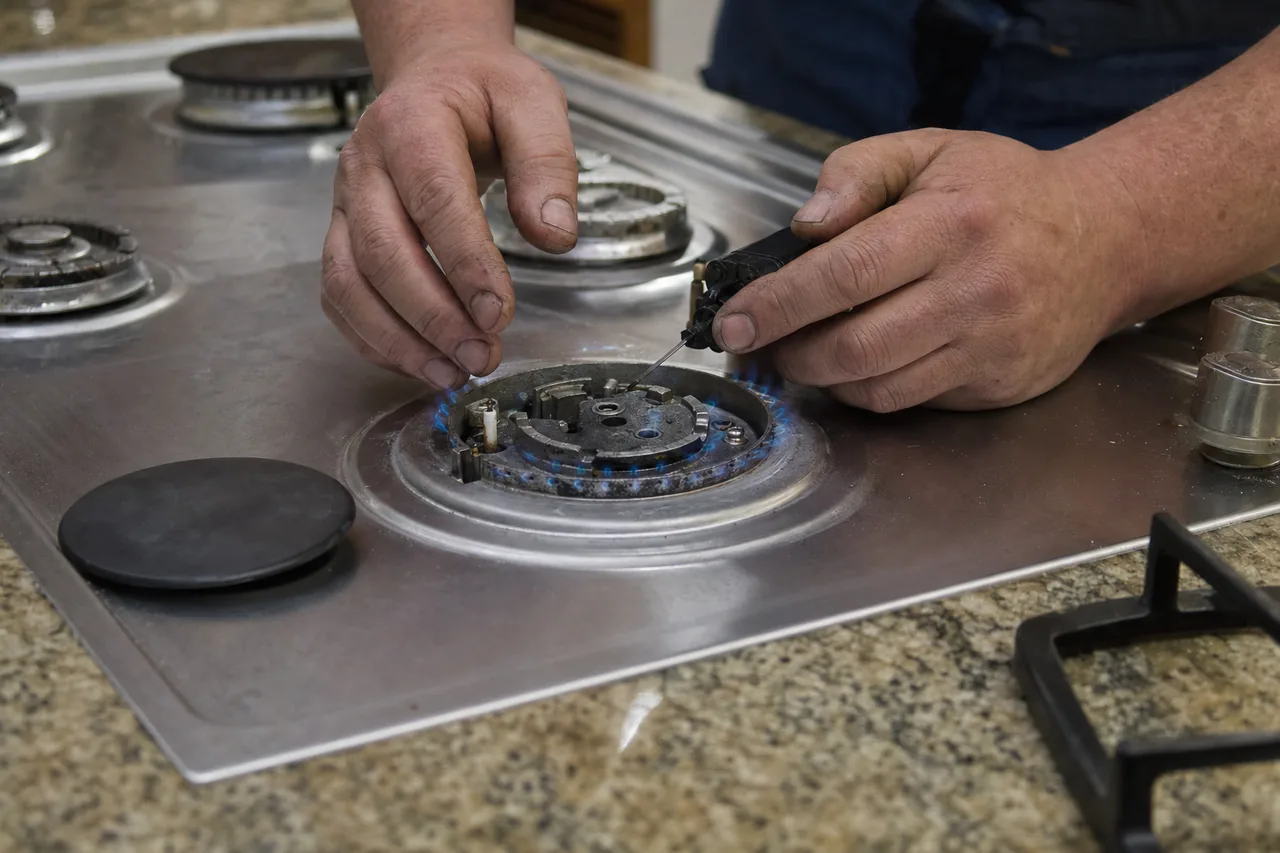
A professional range is the appliance most often at the centre of a Clay County kitchen, and it is the one that shows wear first. It runs hotter, longer and heavier than anything else on the circuit, it combines gas and electronics in a single chassis, and it is the only appliance in the house whose door somebody opens twenty times a day.
What actually fails here
Ranges in this territory fail for mechanical, electrical and thermal reasons, and the four below account for most of what we are called to. Each has a characteristic way of arriving disguised as something else, which is why the order they are checked in matters as much as the list itself.
Ignition. A burner that clicks without lighting is usually a fouled igniter, a cracked igniter ceramic, or a spark module that has lost one output channel. When several burners spark and only one lights, suspect the module before the burners. An electrode knocked out of position during cleaning, or a burner cap seated a few degrees off its register, produces the identical symptom and costs nothing to correct.
Oven temperature. The oven sensor is a resistance probe. As it drifts, the control follows it, and the oven settles above or below the setpoint without ever reporting a fault. A drifting oven is a measurement problem far more often than a heating problem, which is why we measure the cavity independently before anyone talks about elements.
Doors. A professional oven door carries real mass. Hinges wear, springs relax, and the door begins to sag or bounce off the latch. Left alone, the seal loses contact along the top edge, heat escapes continuously, and the control compensates by holding the element on longer. The complaint that reaches us is almost always about temperature; the part that has failed is a hinge.
Control boards after outages. The Jacksonville area records roughly 68 thunderstorm days a year. Boards that survive the strike itself often fail weeks later, and the first sign is an intermittent no-start rather than a dead appliance.
Gas, and the questions worth answering on the phone
Three details change what the technician brings, so they are worth having ready when you call.
Does one burner misbehave, or all of them? A single burner points local — its igniter, its electrode, its cap. All of them points upstream, to the module or the supply.
Does the burner light and then go out when you release the knob? That is the flame-sensing side of the valve rather than the ignition side, and it is a different part entirely.
Is the flame the right colour? A yellow, lazy or lifting flame is describing the air-gas mixture — a blocked port, debris under the cap, or an orifice disturbed during a conversion between natural gas and propane. It is worth acting on early, because a burner running rich soots the electrode and returns as a no-light complaint a few months later.
Ovens, griddles and grill sections
The secondary cooking surfaces are the parts most often written off as unfixable, and they usually are not. A griddle plate that will not come up to temperature is normally its own element or its own control, not the range. A grill section that has stopped working is normally its igniter or its burner rather than the manifold.
Inside the oven cavity, the two faults we separate first are convection and radiant. A convection fan that runs while the oven still cooks unevenly points at airflow — usually a baffle that has been left out after a clean, or a fan that has slowed. A bake element that has failed open leaves the oven heating from one direction, and the symptom is uneven browning long before it is a no-heat.
Access in older Orange Park kitchens
A professional range is heavy and it sits in an opening built around it. In the older housing off Kingsley Avenue and along the river frontage, that opening was frequently sized for equipment that is no longer made, and the current range occupies it with almost no clearance. We plan the pull before we start it, protect the floor and the cabinet faces, and we do not force anything. If a replacement would not fit the existing opening, you will hear that during the diagnostic rather than after the old unit is standing in the middle of the kitchen.
Parts, and why the serial matters
A professional range is not one product. It is a model line that has been revised repeatedly across its production run, and igniters, spark modules, temperature probes and door hardware are frequently superseded part-way through it. The correct component is decided by the serial number as well as the model, which is why we ask for both off the rating plate when you call, and why a photograph of the plate is more useful than a description of it.
That also sets expectations honestly. Genuine OEM components for a range that left production years ago are not always sitting in a regional warehouse. Where a part is going to take time, you get the estimate and the lead time together, before anything is ordered, rather than discovering the wait after you have approved the job.
How the visit runs
We measure before we quote. The diagnostic is a flat $80, credited toward the repair when you approve the work, and you get the estimate in writing before a part is ordered or any labour is billed. Parts are genuine OEM, and the work carries 90 days on labour and 365 days on parts.
Symptoms we hear most
- Burner clicks but will not light
- Igniter keeps clicking after the burner has already lit
- One burner lights while the others only spark
- Oven runs hot or cold against the setpoint
- Oven will not hold a set temperature through a bake
- Door sags, will not stay shut, or drops when opened
- Griddle or grill section stays cold
- Range goes dead after a storm outage
What does range repair cost here?
The researched bands that fit this equipment. Parts and labour together, before the appliance has been measured.
| Work | Usual range | What moves it inside the band |
|---|---|---|
| Finding the fault | $80 | Nothing moves it. One figure for any appliance anywhere in the radius. Flat diagnostic fee, credited toward the repair when you approve the work. |
| Oven thermostat or heating element | $190–$610 | Whether the cavity has drifted out of tolerance or an element has failed open — and whether the oven has to come out of its opening to be reached. |
| Igniter or burner assembly | $190–$560 | Whether one spark channel has gone or the module has, and whether the burner head itself is still serviceable. |
| Control board or touch panel | $410–$1,000 | The board carries most of it. What is left is availability: a long-superseded model line is the slow, dear case. |
Parts and labour together, for this equipment in Orange Park and the rest of the radius. A band is not a quote: the figure you approve is written down once the appliance has been measured, and it lands inside the band above unless you are told on the day why it does not. The whole book, and the replace-instead comparison.
What owners ask about ranges
- Why does the igniter keep clicking after the burner has lit?
- Because the switch that should stop the spark once a flame is sensed has stopped sensing it. The module carries on firing every channel, which points at the switch rather than at the gas. It falls in the igniter or burner assembly band, $190–$560 — and a cap seated a fraction out after a clean does the same thing for nothing.
- The burner clicks and will not light. Is that the igniter?
- Usually the electrode or the spark module rather than the gas. One channel gone quiet while the others still fire points at the module. A burner that sparks hard and still will not catch points at a blocked port, debris under the cap, or an orifice disturbed during a clean. We measure before either is ordered.
- Why measure the oven when the display already shows a temperature?
- Because the display repeats what the probe reports, and the probe is the part that drifts. A cavity can bake well under its setpoint and read correct on the dial. We put an independent probe in the cavity first, so a sensor is only changed when the measurement and the display genuinely disagree.
- What does Viking ranges repair cost in Orange Park?
- $80 flat to find the fault, and that is the whole bill if you decide to stop there. Where the work goes ahead, the bands that apply are oven thermostat or heating element $190–$610, igniter or burner assembly $190–$560, control board or touch panel $410–$1,000, parts and labour together. You get a written estimate before any part is ordered or any labour is billed.
- What happens after the repair?
- 90 days on labour, 365 days on parts, genuine OEM parts. The cover is on the repair that was carried out, not on an unrelated fault that turns up later on the same appliance. A part we ordered from our own diagnosis is fitted on a second visit with nothing further to pay for the trip.
After a ranges visit
4.5 out of 5 from 83 customer reviews. Each entry below is a single visit, in the words of the person who paid for it. See the selection by equipment.
Living on the water has not been kind to the range. He cleaned corrosion off the burner heads, replaced two that were past saving, and treated the trim so it stops eating into the stainless underneath.
Gideon H.2026-06-09
Solid work on a range that has always been awkward to get at. He took the time to protect the floor before drawing it forward. The one thing I would change is more warning about how long the whole visit would run.
Fletcher O.2025-10-28
Roasting had gone unreliable and I had blamed the recipes. He put a probe in and showed me the cavity swinging well past what the dial said, then replaced a tired sensor and reset the offset against it.
Twyla B.2026-03-13
Where we run this work
- Orange Park32073
- Oakleaf Plantation32065
- Pace Island32073
- Doctors Lake32073
Records on this equipment
- Buying a Used Viking Range: What to Check FirstOct 2026
- Viking 5 Series vs 7 Series: What Really ChangesOct 2026
- A Viking Oven Sensor Is Replaced, Not RecalibratedAug 2026
- When a Heavy Viking Oven Door Stops SealingAug 2026
- Why a Viking Board Fails Weeks After the StormJul 2026
- A Viking Burner That Sparks But Will Not LightJul 2026
Also in the van
- Wall Ovenswall-oven
- Refrigerationrefrigeration
- Ventilationventilation
Book a diagnostic
Tell us the model line and the symptom. We schedule Viking work only, so the van carries the right parts.
- Diagnostic
- $80
- Labour warranty
- 90 days
- Parts warranty
- 365 days
Flat diagnostic fee, credited toward the repair when you approve the work. You get a written estimate before any part is ordered or any labour is billed.
Monday to Friday 8:00 am to 6:00 pm, Saturday 9:00 am to 4:00 pm. Closed Sunday.