When a Heavy Viking Oven Door Stops Sealing
Nobody calls about a door. They call because the oven runs cool, browns unevenly, or takes longer than it used to. Often enough the answer is at the hinge.
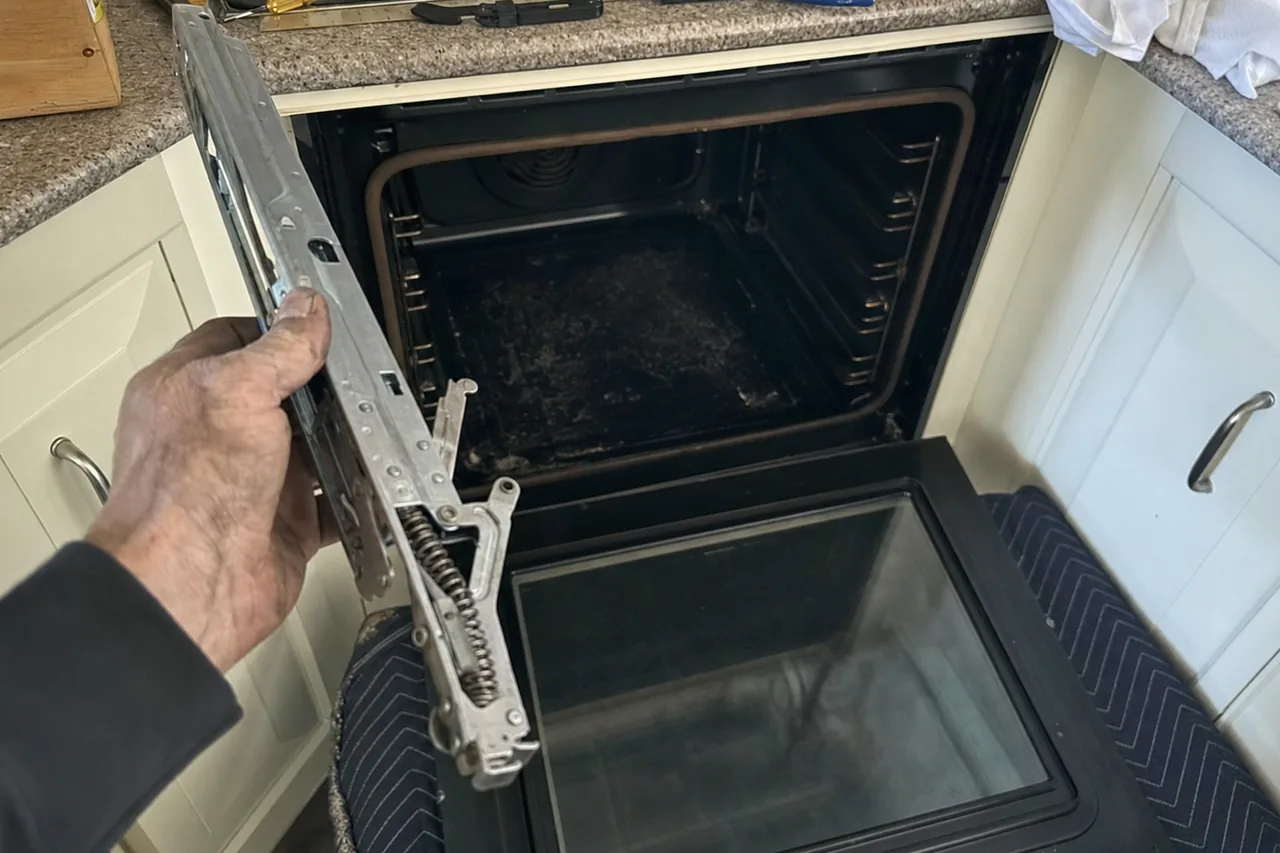
A professional oven door is a genuinely heavy object. Multiple panes of glass, an insulated inner panel, a solid handle and a stainless outer skin, all hung on two hinges and held closed against a seal by spring tension. It is the only part of the appliance that a household moves, by hand, several times a day, for twenty years.
It wears out. And when it does, almost nobody calls about the door.
The complaint arrives as temperature
Here is the sequence, and it completes itself in a large share of the houses we work in around Orange Park and Pace Island where the built-in kitchen is now in its second or third decade.
Hinge bushings wear and the springs relax a little. The door still closes and still latches, but it no longer pulls flush along its top edge — the gap is a couple of millimetres and invisible unless you look for it. Heat leaves through that gap continuously.
The oven control now cannot reach its setpoint as quickly, so it holds the element on longer. Preheat takes noticeably more time. The bottom of the cavity runs hotter than the top because the loss is at the top. Baking goes uneven before anything goes wrong, and the household compensates by turning the temperature up, which makes the bottom-heavy pattern worse.
By the time we are called, the complaint is “the oven runs cool” or “it browns on one side”. The part that has failed is a hinge.
How we tell a door fault from a sensor fault
Both produce a temperature complaint and they need different parts, so this gets settled early with two checks.
First, a straightedge and a light behind the closed door. A door that is flush across its top edge is not the cause; a door with a visible taper is. We also close the door on a strip of paper at several points and compare how firmly each is gripped, which finds an uneven seal faster than any instrument.
Second, an independent temperature measurement in the cavity, compared against what the control believes. If the oven reaches setpoint normally and then loses it, the loss is physical. If the oven never agrees with the setpoint even at rest, the probe has drifted and the control is faithfully following a wrong number.
The two faults also fail differently over time. A door problem gets steadily worse and is worse on long bakes. A sensor problem is constant from the first minute.
Why door hardware sits near the top of the list
Almost everything else in a cooking appliance is either static or electrically switched. The door is the only assembly a household physically loads, several times a day, for twenty years — and it is loaded eccentrically, because the mass hangs out in front of the hinge pivot every time it swings open.
That is why hinge and spring wear tracks with age far more predictably than element or board failure does, and it is why a neighbourhood built out inside a narrow band of years tends to produce these calls in clusters. The self-clean cycle accelerates it. Pyrolytic temperatures are the most punishing hour the hinges, the latch motor and the gasket ever see, and a door that was marginal before a cleaning cycle is frequently obvious after one.
What the repair involves
Hinges are replaced in pairs. Replacing one and leaving its partner in place puts the door out of square and shortens the life of the new part, so we do not do it. The door comes off, the hinge receivers get inspected — they take the load and they can distort — and the spring assemblies are replaced along with the hinges when they have relaxed.
Gaskets are a separate question. A door gasket that has hardened or torn will leak heat even on perfect hinges, and it is a much smaller repair. We check both and quote both, so you can see which one is actually costing you.
Terms
Flat $80 diagnostic, credited toward the repair when you approve the work. A written estimate before any part is ordered. Genuine OEM parts, 90 days on labour and 365 days on parts.
What does this range work cost?
The bands that fit this fault, not the whole book. Parts and labour together.
| Work | Usual range | What moves it inside the band |
|---|---|---|
| Finding the fault | $80 | Nothing moves it. One figure for any appliance anywhere in the radius. Flat diagnostic fee, credited toward the repair when you approve the work. |
| Oven thermostat or heating element | $190–$610 | Whether the cavity has drifted out of tolerance or an element has failed open — and whether the oven has to come out of its opening to be reached. |
| Igniter or burner assembly | $190–$560 | Whether one spark channel has gone or the module has, and whether the burner head itself is still serviceable. |
| Control board or touch panel | $410–$1,000 | The board carries most of it. What is left is availability: a long-superseded model line is the slow, dear case. |
Parts and labour together, for this equipment in Orange Park and the rest of the radius. A band is not a quote: the figure you approve is written down once the appliance has been measured, and it lands inside the band above unless you are told on the day why it does not. The whole book, and the replace-instead comparison.
What this one raises
- Why does a door fault present as a temperature fault?
- Because the control is still holding the setpoint at the probe, and the heat is leaving past a seal that no longer closes. The oven reports nothing wrong. The food reports it instead, as uneven browning or a bake that needs longer than it used to.
- Is a sagging door worth repairing on an older range?
- Usually yes, because it is hardware rather than electronics and the parts involved are the ones still made. Where it is not worth it, we say so in the estimate rather than quote the work and leave you to decide against it afterwards.
- What does this repair cost in Orange Park?
- $80 flat to find the fault, and that is the whole bill if you decide to stop there. Where the work goes ahead, the bands that apply are oven thermostat or heating element $190–$610, igniter or burner assembly $190–$560, control board or touch panel $410–$1,000, parts and labour together. You get a written estimate before any part is ordered or any labour is billed.
The service this belongs to
- Rangesrange
- Wall Ovenswall-oven
Where this comes up
- Orange Park32073
- Pace Island32073
- Eagle Harbor32003
Book a diagnostic
Tell us the model line and the symptom. We schedule Viking work only, so the van carries the right parts.
- Diagnostic
- $80
- Labour warranty
- 90 days
- Parts warranty
- 365 days
Flat diagnostic fee, credited toward the repair when you approve the work. You get a written estimate before any part is ordered or any labour is billed.
Monday to Friday 8:00 am to 6:00 pm, Saturday 9:00 am to 4:00 pm. Closed Sunday.